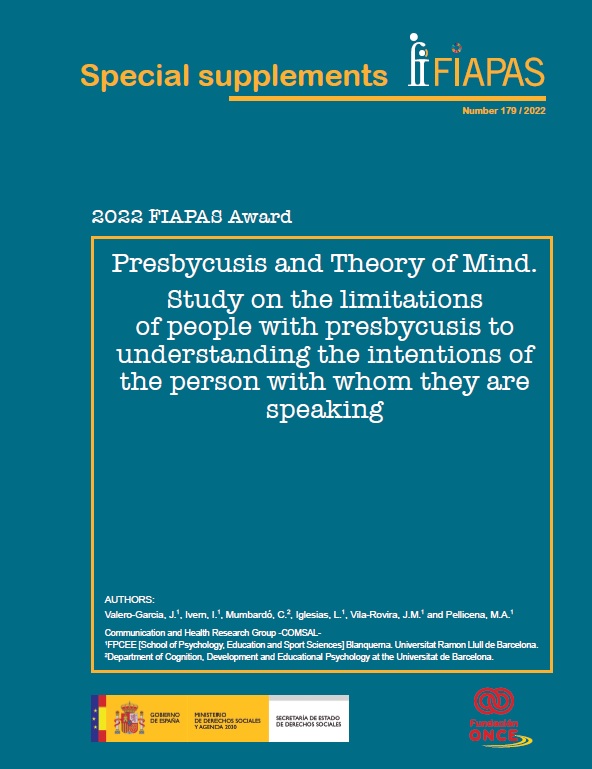
This research paper, on a sample of 141 elderly people (average age 77.9 years), deals with mentalising ability or Theory of Mind (ToM) and how the use of hearing aids better preserves (without statistically significant differences over the hearing population) these abilities, in this case in elderly people with deafness.
ToM, one of the most complex psychological constructs studied in recent decades, refers to the ability to attribute mental states to others, differentiating them from one’s own, and thus to predict and explain their behaviour, wishes, intentions, beliefs and feelings. It is a skill that facilitates interpersonal relationships and reduces the risk of communication misunderstandings.
Although the award-winning work focuses on the adult population with deafness (presbycusis), the basic approach and conclusions are of interest to the entire population with deafness, of any age.
FIAPAS 2022 Award Winner
Reference: Valero-García, J. et al. (2022): Presbycusis and Theory of Mind. Study on the limitations of people with presbycusis to understanding the intentions of the person with whom they are speaking. FIAPAS Journal, 179. I-XVI
©FIAPAS

